
 |
Skip to
| In this issue | ||
|
||
|
||
|
||
| Resources | ||
|
||
What We’re Seeing
Faster acquisition and AI are shrinking the time between opportunity and action. Repeatable speed depends on the growth system behind the pursuit: customer insight, clear decision rights, the right people and processes, and easy access to information. When those elements work together, organizations are better positioned to make decisions and act quickly as opportunities emerge. That ability is becoming an increasingly important source of competitive advantage.
Key Takeaways
As buying timelines shorten, strengths such as a better solution or strong customer relationships help most when the growth system can turn them into sound decisions and action quickly.
Repeatable speed depends on five conditions being in place before the opportunity arrives. Each removes a different delay, and the slowest one tends to set the pace.
When the growth system is slow, the strain tends to show up in the proposal, even when the cause sits upstream. Reviews then tend to focus on the proposal, and the cause often stays in place until leadership addresses it.
Deep Dive
Two of the forces shortening the window are familiar. Federal buying is moving toward faster pathways, which can shorten the time from notice to decision. AI can compress the work of understanding an opportunity from months into days. Leaders across industries recognize the pressure. In Deloitte’s 2026 Global Human Capital Trends survey, 88 percent of leaders rated moving people, skills, data, and technology to where they are needed as extremely or very important. Seven percent said they had made real progress. Because competitors increasingly have access to similar AI tools, some of the advantage that came from analysis alone is shrinking. That makes what a company does with its insight, and how quickly, more important. In Shipley’s experience, much of that depends on five conditions being in place before the opportunity shows up.
If one of these five conditions is slowing your pursuits, talk to a Shipley expert about turning it into documented process your organization can repeat, not just this time.
1. Insight That Arrives After the Clock Starts
The company has to know the customer and the competition before the opportunity is announced. When it does not, discovery starts after the clock does, and the pursuit decision often gets made on thin information under pressure. A common picture: a business development team lets most sources-sought notices go unanswered, because the same people are finishing proposals with deadlines. Each choice makes sense on its own. Together, they let early engagement wait for spare capacity.
Is sufficient customer and competitive insight available early enough to support a sound pursuit decision, or does meaningful discovery begin after the response clock starts?
The decision that addresses it sits with leadership: whether customer insight is something the company funds and keeps current, or something each pursuit rebuilds under deadline.
2. Approvals Built for a Slower Timeline
Someone has to be able to commit resources, change course, or stop a pursuit inside the customer’s timeframe. When decision rights are unclear, the pursuit waits on an approval designed for a longer timeline. The pursuit loses time, and some opportunities are passed up or lost because the company could not act on its strengths quickly enough.
Are decision rights clear enough to commit resources, change course, or stop a pursuit without unnecessary escalation?
The question underneath is one for the leadership team: at what dollar threshold, and within how many days, can the company commit to a pursuit without escalation? If the answer depends on who is asking, decision speed depends on who is in the room.
3. The Right People, in the Wrong Unit
The company has to be able to move its strongest people to a pursuit on short notice, across business units, with accountability clear from day one. When it cannot, the people exist but sit elsewhere, committed to other work, and no one clearly has the authority to move them. The pursuit often goes forward with whoever is available.
Can the right team be assembled quickly, with clear accountability for the win?
Business-unit leaders hold onto their people for good reasons. The enterprise has to decide that a pursuit outranks those reasons, and set incentives so that releasing a strong performer counts as a contribution rather than a loss.
4. Steps That Protect, and Steps That Only Slow
Process should catch a bad decision before it costs money and keep execution disciplined under pressure. Over time, steps that do neither build up around pursuits. Each was added for a reason, but together they slow the path. The useful distinction is between steps that have to approve and steps that only need to know. The first should be few and consolidated. The second should be told, not asked.
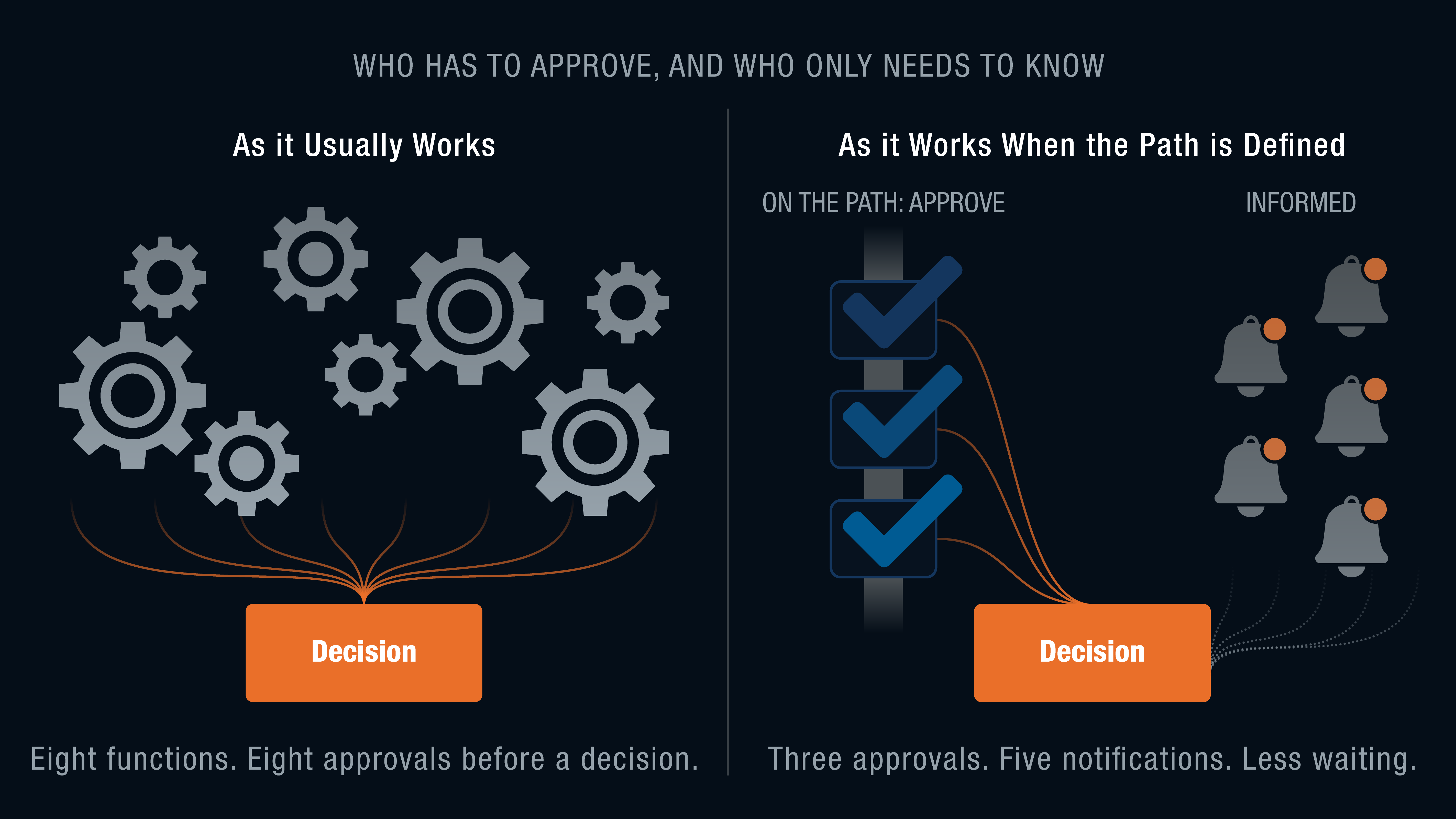 |
Figure 1. Approving and Being Informed Are Different Steps. Steps that decide belong on the path and should be few. Steps that only need to know should be told, not asked.
Does the process accelerate good decisions and disciplined execution, or primarily add required steps?
Deciding which approvals stay on the path, and which functions are informed instead, takes authority over the whole path. That is a governance call for the leadership team.
5. Knowledge the Company Has and Cannot Reach
The team has to be able to find and use what the company already knows: customer history, past performance, pricing, what worked before. When it cannot, pursuits end up rebuilding the answer. The knowledge exists, in a few veterans and in old proposals, but not where the team can reach it in time. AI does not fix this on its own. Faster analysis helps little when the information it needs is scattered or stale, and information can move faster than a company can act on it.
Can teams quickly find and use what the organization already knows, or does each pursuit require rebuilding the answer?
Leadership has to decide whether institutional knowledge is something the company deliberately maintains and makes accessible, or something that remains dependent on individual people. That choice also shapes how much of the company’s AI spending turns into speed.
Where the Problem Gets Diagnosed
The five work as a system, and the slowest tends to set the pace. The delay it causes often shows up somewhere else. When a compressed timeline exposes a gap upstream, the proposal team usually absorbs it, working longer to make up time the system lost. That effort can hide the cause. When the pursuit is lost, the review tends to look at the proposal, because that is where the strain showed and where performance is measured. The upstream constraint often goes unexamined and is still there on the next tight timeline.
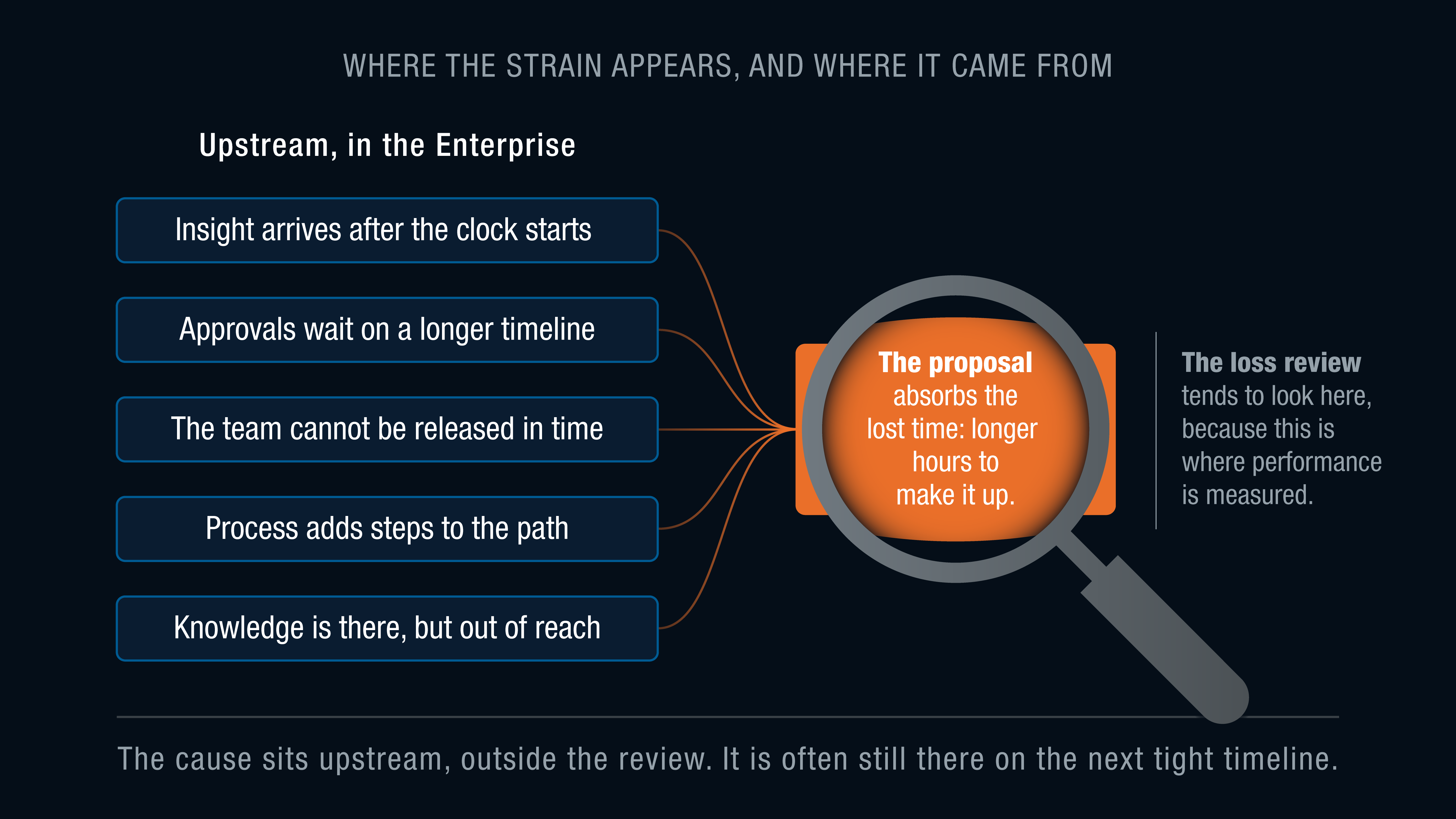 |
Figure 2. The Strain Shows Up Downstream of the Cause. Delays in insight, approvals, people, process, and information tend to show up in the proposal, which is where they usually get diagnosed.
The pattern tends to hold until leadership treats decision speed as something the enterprise owns. Decision speed is an enterprise growth capability, not simply a capture or proposal concern.
Where Leadership Comes In
Shipley’s recent series in this newsletter, Rapid-Response Organizational Readiness, covered what readiness looks like inside the pursuit team. This piece has been about the decisions above it.
As acquisition timelines compress, the constraint on growth is shifting from finding opportunity to acting on it fast enough. The organizations that convert insight into decisions and coordinated action, consistently, are building that capability deliberately. The rest are relying on circumstance.
Some of that building can start now. Registering before year-end locks in this year's rates for 2027 delivery. Lock in 2026 rates on Shipley corporate training for your team.
The AI Edge
This Issue’s Prompt: Would a Competitor Say the Same Thing?
“Here is a section of our draft: [paste section]. For every claim we make, tell me whether a qualified competitor could make the identical claim with a straight face. Sort the claims into three buckets: claims only we can make and prove, claims most competitors could also make, and claims that are pure assertion with no evidence attached. For anything in the second or third bucket, tell me what specific evidence would move it into the first — or recommend cutting it.”
“Proven track record.” “Highly qualified team.” “Customer-focused approach.” Every bidder writes them, which is precisely why they score nothing. This is a mechanical version of a question good reviewers ask by instinct and inconsistently. Run it on the section you’re proudest of — that’s usually where the boilerplate is hiding, because confident writing and evidenced writing feel the same from the inside. If you want to go deeper on applying AI across the full proposal lifecycle, Shipley AI 2026 course covers practical applications from capture through final submission.
Worth Your Time
On the Schedule
Ready to build the discipline into your team? See upcoming courses.
| Oct 28 – Nov 25, 2026 | |||||||
| October | |||||||
|
|||||||
| November | |||||||
|
|||||||
|
|||||||
|
|||||||
|
|||||||
|
|||||||
|
|||||||
|
|||||||
|
|||||||
|
|||||||
|
|||||||
Your Turn
Think about the last time a fast-moving opportunity caught your team flat-footed. Which of the five conditions was actually the bottleneck: insight, approvals, people, process, or information? Hit reply and tell us.
